
A landing page looks like a simple format only at first glance. One page, several sections, a contact form, a clear call to action – it seems as if there is not much to build. But this simplicity is exactly why landing pages are often created too superficially: a nice hero section, a few promises, a form at the bottom, and that is all. Then advertising starts, clicks come in, and leads remain weak.
The problem is usually not that a landing page does not work as a format. It does work, but only when it has a clear task, a strong structure, and a logical path for the user. A visitor does not come to a landing page to study the company for an hour. They want to quickly understand what is offered, whether it fits their need, whether the company can be trusted, and what to do next.
That is why landing page development should not start with design. First, you need to define the offer, the audience, the target action, and the logic of persuasion. A landing page should guide a person briefly, but not aggressively: explain the point, give arguments, remove doubts, and lead them to a request.
Estetic Web Design creates landing pages not as a set of attractive sections, but as focused pages for a specific business task: a service, product, expert offer, advertising campaign, B2B direction, or a test of a new proposal.
When One Page Is Enough, and When a Full Website Is Better
A landing page works well when a business needs to promote one clear offer. It may be a specific service, consultation, industrial product, event, course, promotion, engineering solution, or personal brand. In such cases, one page helps keep the user focused instead of sending them through many sections.
If a person comes from an ad with a specific request, they do not always need a large website. They need a page that answers their exact question: What is this? Who is it for? What does the price depend on? How can I get a consultation? Why can this company be trusted?
Still, a landing page should not replace the whole website in every case. If a business has many services, a large catalog, several audiences, a blog, case studies, city pages, or a deeper SEO structure, one page will be too limited. In that case, a corporate website or a multi-page structure is a better base, while the landing page can work as a separate advertising page.
| Task | What fits better |
| Promote one service | Landing page |
| Launch an advertising campaign | Landing page or a series of dedicated pages |
| Test demand for a new direction | One-page website |
| Present an expert | Portfolio landing page |
| Show many services and cases | Corporate website |
| Sell products online | Online store |
| Grow for many search queries | Multi-page website |
A landing page is strong where there is focus. Without focus, the page quickly turns into an overloaded presentation about everything at once.

A One-Page Website Starts with One Clear Offer
A good landing page has a central idea. It can be expressed in one or two sentences without a long explanation. If that is not possible, the offer is probably not ready for a landing page yet.
Examples may include business fuel briquettes, an ESG expert consultation, elevator equipment maintenance, energy-efficient system design, course registration, service cost calculation, or a product presentation for B2B clients.
It is important not to squeeze all company directions into one landing page. One page should work with one main user intent. Otherwise, the visitor gets lost: they came for a specific solution, but the page shows the full service list, company history, news, gallery, partners, and ten different buttons.
Before ordering a landing page, it is worth answering several questions:
- who will visit the page;
- where the traffic will come from;
- what action should be received;
- what main doubt the client may have;
- what proof can be shown;
- whether a price, range, or calculation is needed;
- who will process the requests;
- what happens after the form is submitted.
Without these answers, creating a landing page becomes guesswork. The page may look good, but it may fail to match the audience’s expectations.
How a Landing Page Leads a User to a Request
A one-page website works in sequence. It does not have dozens of sections, so the order of blocks matters. The user should move through the page almost without effort: understand the offer, see the value, get the details, trust the company, and send a request.
A strong landing page usually answers questions in this order:
- What is being offered?
- Who is it for?
- What problem does it solve?
- Why can this be trusted?
- What is included in the service or product?
- How does the process work?
- How much can it cost, or how can the price be calculated?
- What examples, reviews, or facts can be shown?
- What should the user do now?
This is not a rigid template. In B2B, there may be more facts and logistics. In an expert landing page, more attention goes to trust in the person. In a technical service, more explanation and stages may be needed. In an advertising page, the path to the request is usually shorter.
The main point is not to turn a landing page into a set of identical sections. Every block should move the user forward. If a block does not explain anything, strengthen trust, or help a person decide, it is better to remove it.
What a Landing Page Should Include
One page does not mean minimum information. On the contrary, a landing page should be dense in meaning. After viewing it, the user should not wonder: What exactly do they do? How long will it take? Who is this for? Why should I leave my contacts?
Most landing pages need the following elements:
- a hero section with a clear offer;
- a short explanation of the service or product;
- a “who it is for” or “when it fits” section;
- specific advantages;
- offer details;
- photos, diagrams, examples, or visuals;
- work stages;
- trust elements;
- reviews, cases, or facts;
- FAQ;
- request form;
- contacts;
- analytics and goals.
Empty phrases should be avoided. “Individual approach”, “high quality”, and “professional team” do not help if there are no details behind them. If the page needs new texts or clearer blocks, copywriting should be prepared together with the structure, not after the design is already finished.
Another important point: not every landing page has to be long. If the offer is simple, the page can be more compact. But if the service is complex or expensive, a short page may not have enough space to convince the user.
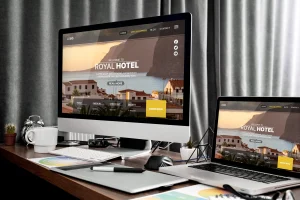
Landing Page Design Should Guide Attention
Landing page design is not decoration for the sake of beauty. It should help the user read, understand, and act. People scan the page quickly: headings, buttons, photos, short paragraphs, numbers, highlighted blocks. If everything looks the same, the eye has nothing to catch.
For a landing page, the following details are especially important:
- a strong hero section;
- readable headings;
- normal contrast;
- clear buttons;
- enough space between sections;
- a clear visual hierarchy;
- realistic images;
- mobile adaptation;
- quick access to the form.
Sometimes a business wants a “wow design”, but the page needs clarity more than effects. For an industrial product, equipment service, or engineering offer, excessive animation may get in the way. Calm structure, specific facts, simple diagrams, and a quick contact often work better.
For a personal brand, event, beauty direction, or visual product, emotion may play a larger role. But even there, design should not cover the message. A landing page is not created so that users admire the layout. It is created so that they understand the offer and leave a request.
Landing Page for Advertising: Why the Home Page Often Loses
A common situation: a business launches ads for a specific service but sends users to the home page. The user clicked an ad about one service, but landed on a general website where they now have to search for the relevant section. Part of the audience leaves immediately.
A landing page works better when it continues the message of the ad. If the ad promises a cost estimate, the page should have a calculation form or a request for a quote. If the campaign promotes a consultation, the page should show the expert, the format, topics, and booking button. This is especially important for Google Ads, where each click is paid and the page has to match the user’s intent.
A landing page is useful for advertising when you need to:
- quickly test demand;
- collect leads for a specific service;
- promote a new product;
- launch a special offer;
- collect registrations for an event;
- present an expert;
- test a new audience;
- create a separate page for search ads or social traffic.
The page should not be overloaded with extra routes. The more options the user has, the weaker the focus becomes. On a landing page, there should be one main path.
Forms, CRM, and Analytics: What Happens After the Request
The form on a landing page should be simple, but not random. For a quick consultation, a name and phone number may be enough. For a calculation, the city, service type, comment, file, or several parameters may be needed. For a B2B request, the company, volume, region, and deadlines may matter.
But it is easy to overdo it. If the form has too many required fields, some users will not send it. It is often better to collect the minimum at the first step and clarify details during the conversation.
It is also important to plan the path of the lead after submission:
- where the request goes;
- who processes it;
- whether the client receives confirmation;
- whether the lead enters the CRM;
- whether the traffic source is recorded;
- whether analytics goals are configured;
- whether it is clear which campaign brought the lead.
Otherwise, the landing page may look as if it works, but the business will not see the full picture. Leads get lost in email, managers do not know where the client came from, and advertising is evaluated by guesswork.
SEO for a One-Page Website: Without Exaggerated Promises
A landing page can be prepared for SEO, but the limits of the format must be understood. A one-page website has one URL and one main intent. It cannot fully replace a large website with many pages for different search queries.
Still, basic SEO preparation is important, especially if the landing page should receive not only paid traffic but also organic visits.
What should be done:
- choose one main query cluster;
- write a proper title and description;
- use one logical main heading;
- build subheadings without chaos;
- add text without keyword stuffing;
- optimize images;
- improve loading speed;
- make the mobile version convenient;
- connect analytics;
- set goals;
- add structured data if it fits.
SEO for a landing page is not a promise to rank for everything. It is careful preparation for one specific topic: landing page development, ordering a one-page website, a business landing page, a specific product supply, an expert consultation, or a service page.
If a business needs visibility for dozens of services, cities, or categories, it is better to build a multi-page website. In that case, a landing page can still work as a separate advertising page.
Estetic Web Design Cases: One Page, Different Tasks
A landing page may look like a simple format, but the business tasks behind it can be very different. One project needs to explain an industrial product quickly, another has to build trust in an expert, a third one presents a technical service, and a fourth one explains an engineering solution.
Lintar: Industrial Product and Clear Supply Terms
For Lintar, the landing page had to present a supplier of coal and briquettes. In this niche, decorative sections are less important than business clarity: what is supplied, who the product is for, what the conditions are, how to get in touch, and why the supplier can be trusted.
Such a landing page should not look like an emotional advertising page. It needs a clear structure, practical wording, emphasis on the product, logistics, and contact. A user in an industrial niche does not want to be inspired for a long time. They look for information that helps them make a decision.
Maryna Saprykina: Landing Page for an Expert
A personal landing page works differently. Here, trust in a person matters more than a standard service or product. For Maryna Saprykina, the page needed to show expertise, areas of work, experience, consulting, coaching, achievements, methods, and a clear way to get in touch.
On such a page, the personality has to be presented carefully. It should not be overloaded with biography, but it has to give enough facts to show the expert’s level. Professional background, consultation topics, social proof, publications, reviews, and a clear contact button work well here.
Rembudlift: A Service Company Without Unnecessary Effects
The landing page for Rembudlift was connected with elevator equipment repair and maintenance. This is a technical service where users need to quickly understand the company’s competence: what work is performed, what equipment is serviced, what experience the team has, and how to send a request.
In such projects, complex visual effects are not needed for the sake of impressions. A simple structure, clear services, accurate presentation, facts, contacts, and trust in the contractor work better.
Boostengineering: An Engineering Solution on One Page
Boostengineering is an example of a landing page for an engineering company. The task is to explain a complex service without overloading the page with terminology. The user should understand the areas of work, the value, the technical logic, and the next step.
The difficulty of such projects is balance. If the text is too simple, the service looks shallow. If it is overloaded with technical terms, part of the audience will stop reading. A good landing page translates a complex solution into clear language without losing the professional level.
These cases show the main point: landing page development should not follow one universal pattern. A one-page website for an industrial product, an expert, a service company, and an engineering solution are four different scenarios.

How Much Landing Page Development Costs and What Affects the Timeline
The cost of a landing page depends not only on the number of sections. One project may be a short page with ready-made text and photos. Another may include custom design, copywriting, animation, several forms, CRM, analytics, multilingual versions, and SEO preparation.
The price is usually affected by:
- design complexity;
- number of content blocks;
- readiness of materials;
- need for copywriting;
- quality of photos and visuals;
- request forms;
- integrations;
- multilingual versions;
- animation;
- analytics;
- SEO base;
- urgency of launch.
The timeline also depends on preparation. If the client has texts, photos, a clear offer, and a ready structure, the landing page can be launched faster. If everything needs to be prepared from scratch, the meaning has to be worked through first, and only then design and development can start.
A fast launch should not mean a raw launch. Even one page has to be checked: mobile version, speed, forms, display on different devices, request delivery, and analytics.
When to Improve a Landing Page and When to Scale It into a Website
A landing page is often launched as a first step. The business checks demand, collects leads, tests advertising, and watches audience reactions. If the direction works, the page can be developed further.
Sometimes it is enough to improve the landing page itself: rewrite the hero section, add cases, strengthen the FAQ, improve the form, connect CRM, add reviews, speed up loading, polish the mobile version, or change the order of blocks.
If the landing page is already bringing traffic but some functions or sections are missing, it can be better to make targeted website improvements instead of rebuilding everything from scratch.
But sometimes the landing page becomes too narrow. New services appear, separate directions are needed, city pages become relevant, a blog is planned, a catalog is added, SEO plans expand, or the business starts working with different audiences. Then it is better to scale the project into a full website.
It is good when this is considered in advance. If a landing page is built on a solid technical base, it is easier to develop. If it was created as a temporary placeholder without structure, scaling often turns into a full rebuild.
Why Order a Landing Page from Estetic Web Design
Estetic Web Design develops turnkey landing pages for businesses, experts, service companies, industrial projects, and engineering directions. We do not start with a template. We start with the task: who should come to the page, what they need to understand, and what action they should take.
The work may include structure, design, texts or content adaptation, development, mobile version, forms, analytics, basic SEO preparation, and publication. If needed, we connect CRM, messengers, email services, API, and other tools so the request does not just get sent, but actually enters the workflow.
A turnkey landing page is not “one cheaper page”. It is a precise page for a specific goal. It should quickly explain the offer, hold attention, build trust, and lead to action.
If you need to test a service, launch advertising, present a product, collect leads, or create a separate page for a specific direction, you can order a landing page from Estetic Web Design. We will build it not as a random set of blocks, but as a working tool for requests.
Leave a Reply